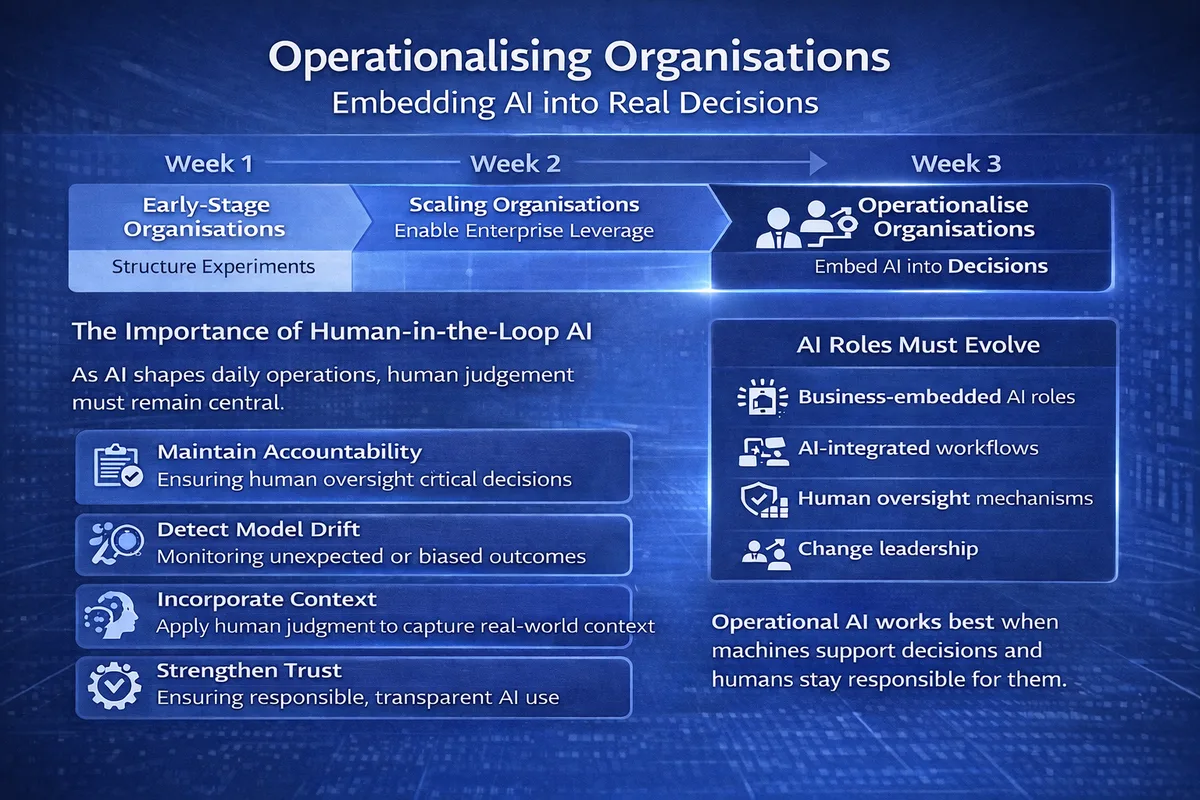
Operationalising AI is the transition most organisations underestimate. This is the stage where AI moves beyond pilots and platforms and begins to shape real business decisions and workflows.
Building models is one challenge. Embedding them into daily operations is another entirely. Success at this stage depends less on algorithms and more on integration, adoption and trust, which is exactly where human oversight becomes critical.
Why human-in-the-loop matters
As AI starts to influence operational decisions, organisations have to make sure human judgement remains central. Not because AI lacks capability, but because enterprises operate in complex environments where context, ethics and accountability matter more than raw model output.
Human-in-the-loop design helps organisations:
- Maintain accountability for critical decisions.
- Detect model drift or unexpected outcomes before they cause damage.
- Incorporate contextual judgement that a model cannot capture.
- Strengthen trust among employees, partners and customers.
- Ensure responsible and transparent use of AI in high-stakes decisions.
Operational AI works best when machines augment decisions and humans remain responsible for them.
How AI teams have to evolve
To operationalise AI effectively, organisations typically need to bring in:
- Business-embedded AI roles that sit directly with operational teams, not just in a central AI function.
- Process redesign capability to integrate AI into workflows rather than beside them.
- Human oversight mechanisms for high-impact decisions.
- Monitoring and governance structures to maintain performance and trust over time.
- Change leadership to support adoption across the organisation.
From model builder to decision partner
At this stage the AI team is no longer just a builder of models. It becomes a partner in the enterprise's operational decision systems. That's a very different job, with very different KPIs.
Real AI transformation happens when intelligence is embedded into how work gets done, not just how models get built.
Next in the series: how organisations move from operational AI to building enterprise AI capability that compounds over time.
The moment AI touches a real decision, the operating model has to grow up with it. That's the transition most enterprises are quietly in right now.