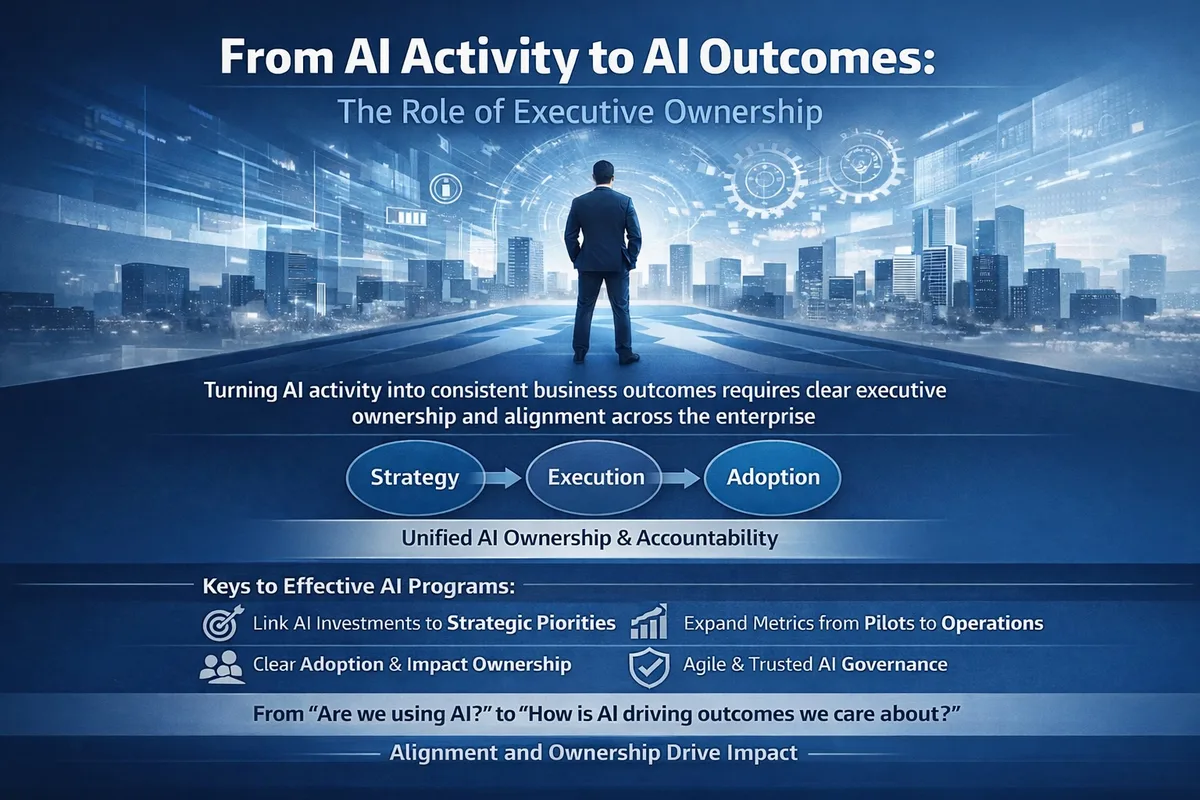
Many organisations are making steady progress on AI adoption. The harder job now is turning that activity into consistent business outcomes. At enterprise scale, AI value depends less on individual models and more on how ownership is defined across strategy, execution and adoption.
When responsibility is spread across multiple functions with no clear end-to-end accountability, value realisation becomes difficult to sustain and measure. The technical work continues, but the business outcome quietly stalls, and no one is quite sure who is meant to unstick it.
What actually sustains AI value
Across the programmes I've watched succeed, the pattern is remarkably consistent. Effective AI programmes tend to share four characteristics, none of them technical:
- Explicit linkage between AI investments and strategic priorities, not just to a use-case backlog.
- Clear ownership for adoption and decision impact, not just delivery of a model or dashboard.
- Measurement frameworks that extend beyond pilots into ongoing operations, with numbers boards can actually track quarter to quarter.
- Governance that enables speed while maintaining trust and risk discipline, one that clears the path rather than blocking it.
The shift in the boardroom question
For boards and executive teams, the useful question is no longer “Are we using AI?” That question has become almost meaningless. Everyone can point at something.
The better question is: How is AI improving the outcomes we actually care about? Growth. Productivity. Resilience. Risk reduction. Customer experience. If AI can't be located inside those conversations, the ownership picture underneath probably isn't clear yet.
From activity to capability
When ownership and alignment are clear, AI moves from being an initiative to being a capability. The enterprise stops asking whether the pilot worked and starts asking how the capability is compounding.
That transition is what executive ownership is really for. Not to sponsor projects: plenty of AI projects have sponsors. To own the outcome that AI is meant to move, and to keep owning it long after the delivery team has shipped.
When ownership is clear, AI moves from initiative to capability, and from experimentation to impact.