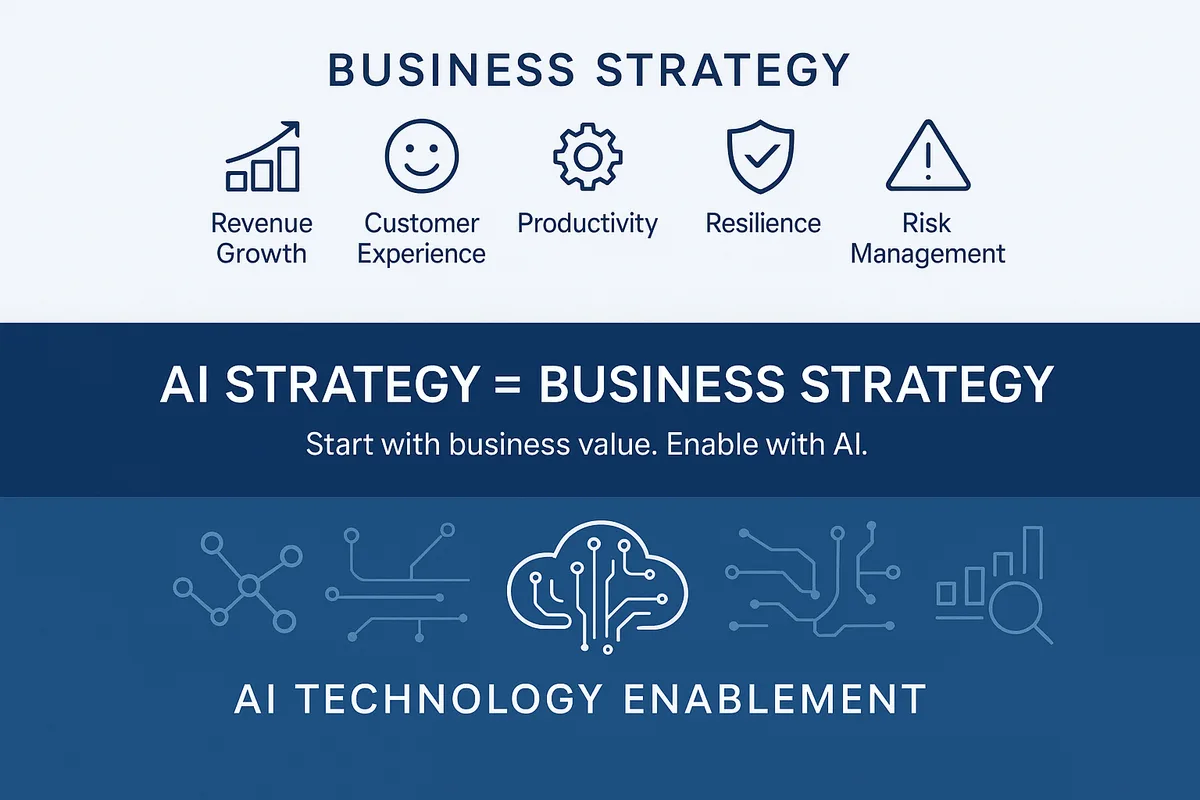
AI strategy is business strategy. If it doesn’t begin with growth, productivity, resilience, risk and competitive advantage, it isn’t strategy at all. It’s a shopping list of use cases dressed up as one.
I’ve sat in enough “AI strategy” sessions to notice a pattern. The conversation almost never begins with the business. It begins with the technology. Someone opens a slide of a model, a vendor, or a use-case matrix; the room reacts; and within twenty minutes the discussion is about tools instead of outcomes.
That order is backwards, and it’s the single biggest reason enterprise AI programmes underperform.
Start with the business decision, not the model
Every AI investment I’ve seen create real, defensible advantage began with a business question that mattered to the P&L or the customer, not with a model or a platform. The question came first. The model was consequence.
A useful test: if you removed AI from the sentence, would the business still care about the outcome? If yes, you have a strategy. If no, you have a science project.
Five lenses that make AI strategy real
Every enterprise AI programme worth funding should be visibly connected to at least one of these five outcomes:
- Growth: new revenue, new segments, new pricing power.
- Productivity: measurable output per unit of cost, time or headcount.
- Resilience: the ability to keep operating when something breaks.
- Risk: reducing exposure, or making risks visible earlier.
- Competitive advantage: something the enterprise can do that others structurally cannot.
If a programme can’t be located on that map, its funding case is weak, regardless of how sophisticated the model is.
What this means at the leadership table
The board’s AI conversation shouldn’t start with “which model, which vendor, which platform.” It should start with “which of these five outcomes are we trying to move, by how much, in what timeframe, and who owns it.”
Get that ordering right and the rest of the AI conversation (models, platforms, talent, governance) falls naturally into place. Get it wrong, and no amount of tooling will fix it.
AI is not a technology transformation. It’s a business transformation. The strategy discipline is the same one every good CEO already knows. AI just raises the stakes of getting it right.