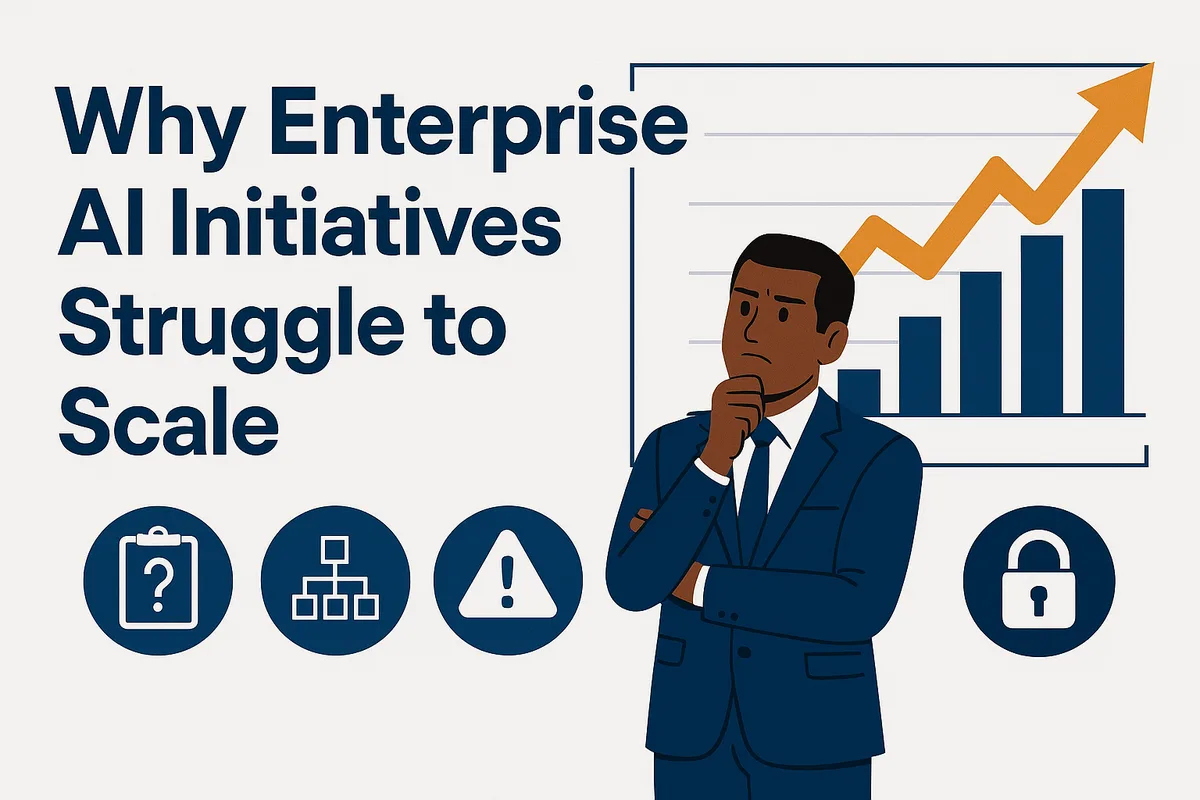
AI pilots don’t fail because the model was wrong. They fail because the operating model, ownership and governance around the model weren’t ready to absorb it. The pilot works. The programme doesn’t.
I’ve watched this pattern play out enough times, across enough industries, that I’ve stopped believing the technical explanation. The technical work is usually fine. What’s missing is everything that surrounds it.
The pilot-to-programme gap
A pilot has three things a programme rarely inherits: a small, motivated cross-functional team; a business sponsor who is personally invested; and an implicit permission to bend the rules. Take any of those away and the same model, running against the same data, quietly stops delivering.
The gap between pilot and programme is not a technical distance. It’s an organisational one.
What actually stalls
When I trace stalled AI programmes back to their root cause, four things come up over and over:
- Ownership becomes ambiguous. The pilot had a name attached to it. The programme has a “steering committee.” No individual is accountable when adoption slows.
- Funding turns into an annual battle. Pilots get one-off funding. Programmes need multi-year commitments, and most enterprises don’t have a category for that yet.
- Governance is bolted on after the fact. Risk, compliance and audit arrive halfway through and treat the programme as a threat to manage, not a capability to enable.
- Change management is treated as training. The pilot changed how a few dozen people worked. The programme requires changing how thousands work, and the plan for that usually doesn’t exist.
The four questions that keep programmes alive
Before an AI pilot moves into scale, the sponsoring executive should be able to answer these four questions in one sitting:
- Who owns adoption on the business side, by name, not committee?
- What operating decisions will change as a result of this AI, and who signs off on those changes?
- How is risk being carried, and who signs the risk memo?
- What is the enterprise capability we’re building, not just the use case we’re shipping?
If any of those don’t have a crisp answer yet, the programme is unlikely to scale. The technical team can keep improving the model, but they’re solving the wrong problem.
The uncomfortable takeaway
Enterprise AI is an operating discipline before it’s a technical one. The organisations pulling ahead in AI aren’t the ones with the best models. They’re the ones that decided, early, to treat AI as an operating capability, and built the ownership, governance and rhythm around it before the pilot ended.
Pilots test whether the model works. Programmes test whether the enterprise can carry it. Only one of those tests matters at scale.