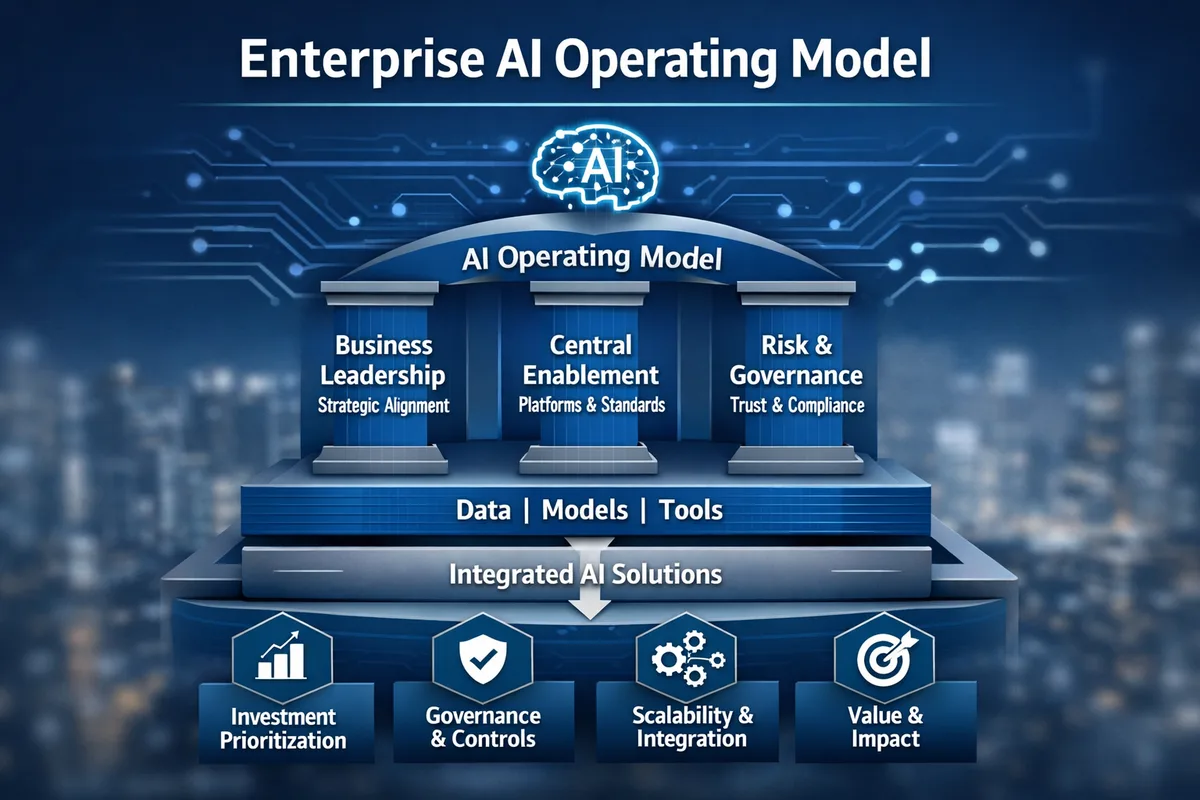
Use cases without an operating model produce noise. Operating models with use cases produce advantage. The order matters, and most enterprises reverse it.
The default AI conversation in most large organisations sounds like a shopping list. Someone opens a spreadsheet of forty potential use cases, ranks them by “impact vs. effort,” and starts shipping the top ten. Two years and a modest budget later, the list is longer, some pilots worked, some didn’t, and nobody can quite say what the enterprise is now able to do that it couldn’t do before.
That’s the signature of a use-case-first approach. It looks like activity. It rarely produces capability.
Six things an operating model has to answer
A functioning AI operating model gives an enterprise a stable, repeatable way to answer six questions that use-case lists can’t answer on their own:
- Decision rights: who chooses which AI programmes get funded, paused or killed?
- Ownership: who is personally accountable for adoption and outcomes on the business side?
- Funding cadence: how do multi-year AI capabilities get funded when annual budgets weren’t designed for them?
- Risk posture: how much AI risk are we prepared to carry, in which parts of the business, at what level of governance?
- Data foundations: who owns the data quality, lineage and access that AI depends on?
- Adoption mechanisms: how does an AI capability actually get into the daily rhythm of the people whose work it changes?
Use cases live inside this frame. Without it, they float.
Signs the operating model is missing
Some signals that a use-case list is running ahead of the operating model:
- The same debate about “who owns AI” keeps recurring every quarter.
- Governance shows up late, and defensively.
- Successful pilots quietly stop being invested in, with no explicit decision to stop.
- Every AI conversation ends with a request for “more use cases” rather than more capability.
- The person the CEO calls about AI changes every six months.
Building the operating model first
The higher-leverage move for most enterprises is to spend three to six months building the operating model (decision rights, ownership, funding, risk, data, adoption) before scaling the use-case portfolio. It feels slower. It compounds faster.
Once the operating model exists, the use-case list becomes something entirely different: a portfolio the enterprise can actually absorb, govern, and scale. Not a hopeful spreadsheet.
Use cases are the outputs of a good AI operating model. If you start with the outputs, you’ll spend years working backwards to build the machine that was supposed to produce them.