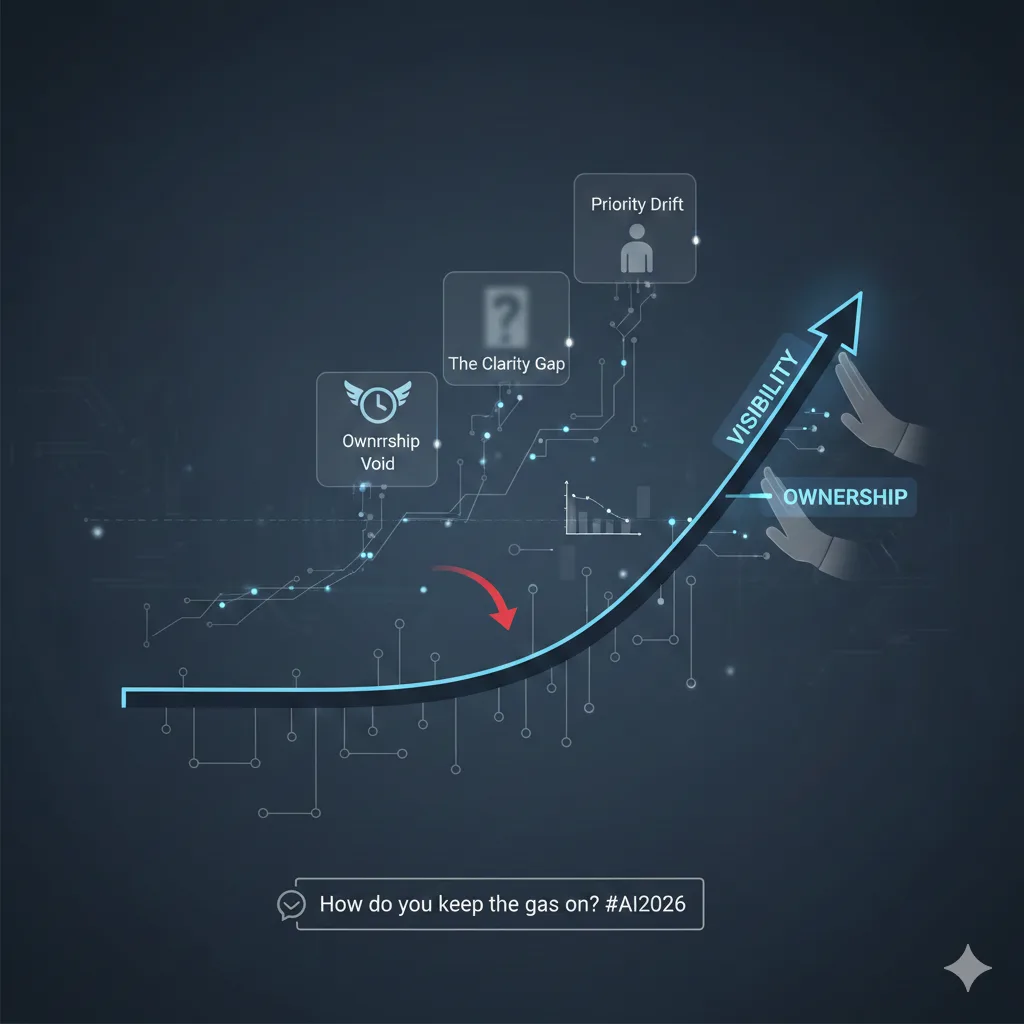
Every AI journey hits a plateau. Not because the technology stops working, but because organisational attention shifts. The pilot ends, the excitement fades, and the room quietly loses interest. That silence is the single biggest killer of enterprise digital transformation.
Nobody announces it. There's no all-hands where AI is officially deprioritised. It just goes quiet, and quiet, in most large organisations, is the same thing as dead.
Why the silence sets in
Three patterns show up almost every time:
- Priority drift: leadership attention moves to the next quarter's big thing. AI is still on the deck, but no longer on the agenda.
- The clarity gap: teams aren't sure how to translate a pilot into a daily workflow, so momentum evaporates while everyone waits for someone else to figure it out.
- Ownership void: no single person is accountable for long-term integration, so no one takes the fight when it needs to be taken.
None of these are technical problems. All of them are leadership problems that look like technical stalls.
What actually keeps momentum going
Scaling AI is roughly 20% technology and 80% persistence. The organisations that successfully embed AI are the ones that double down on visibility and ownership exactly when the initial hype starts to dip, not the ones that assumed the momentum would carry itself.
Practically, that means:
- Keeping AI outcomes on the standing exec agenda long after the pilot is over.
- Naming a single accountable owner for adoption, by name, not by committee.
- Publishing a small number of visible, business-language metrics so it's obvious when things are still moving (and when they aren't).
The question worth asking
How is your organisation keeping its foot on the gas after the initial pilot?
If the honest answer is “we're not sure any more,” the silence has already started.
AI transformation doesn't fail loudly. It fails quietly, over about six months, while everyone assumes someone else has it in hand.