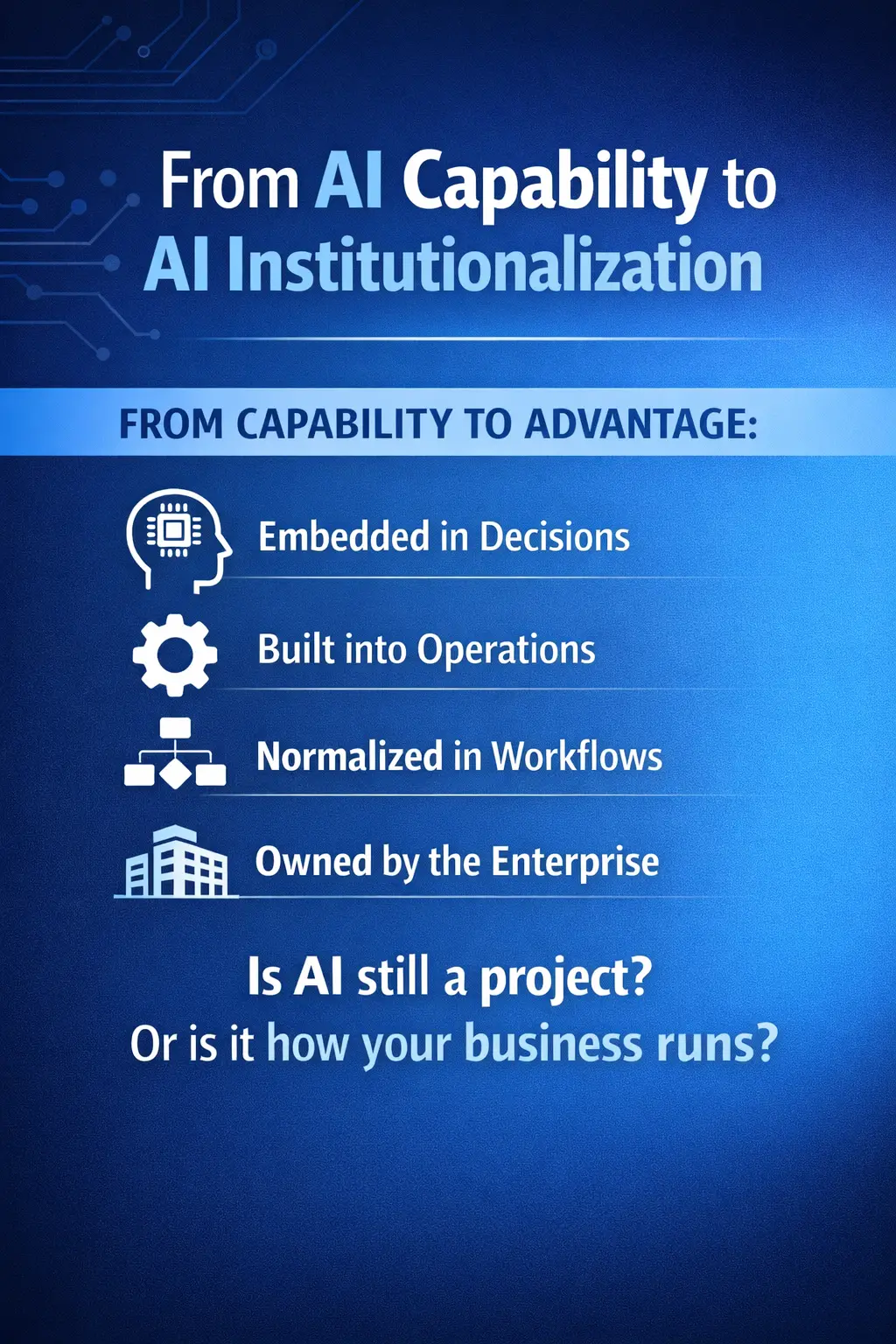
Building AI capability is important. But it's not the end goal. Institutionalising it is. Many organisations are investing seriously in platforms, tools, talent, governance and operating models. That creates capability. Capability, on its own, doesn't create real advantage.
Where advantage actually comes from
Advantage comes when AI becomes part of everyday work:
- When it's embedded in decision-making, not consulted on the side.
- When it's built into operating models, not bolted on to them.
- When it's normal in daily workflows, not a specialist detour.
- When it's governed clearly, so risk is a constraint rather than a blocker.
- When it's owned by the enterprise, not a team or a function.
Notice what's missing from that list: any mention of a model, a platform, or a vendor. Those are inputs. Institutionalisation is what the enterprise builds around them so the intelligence actually shows up in real decisions.
The transformation is structural
The real transformation isn't technological. It's structural. It's the point at which the organisation's answer to “how do we do this?” already includes AI, because AI is part of the operating rhythm, not a separate initiative sitting alongside it.
That's a much harder milestone to hit than a successful pilot. It requires the enterprise to change what it considers “normal work.” And that change is measured in years, not sprints.
A useful leadership question
Is AI still a project your organisation is working on, or is it already part of how people actually work every day?
Two very different answers. Two very different organisations. And the gap between them is exactly where enterprise AI advantage lives.
Capability is potential. Institutionalisation is what turns potential into an operating discipline that compounds.