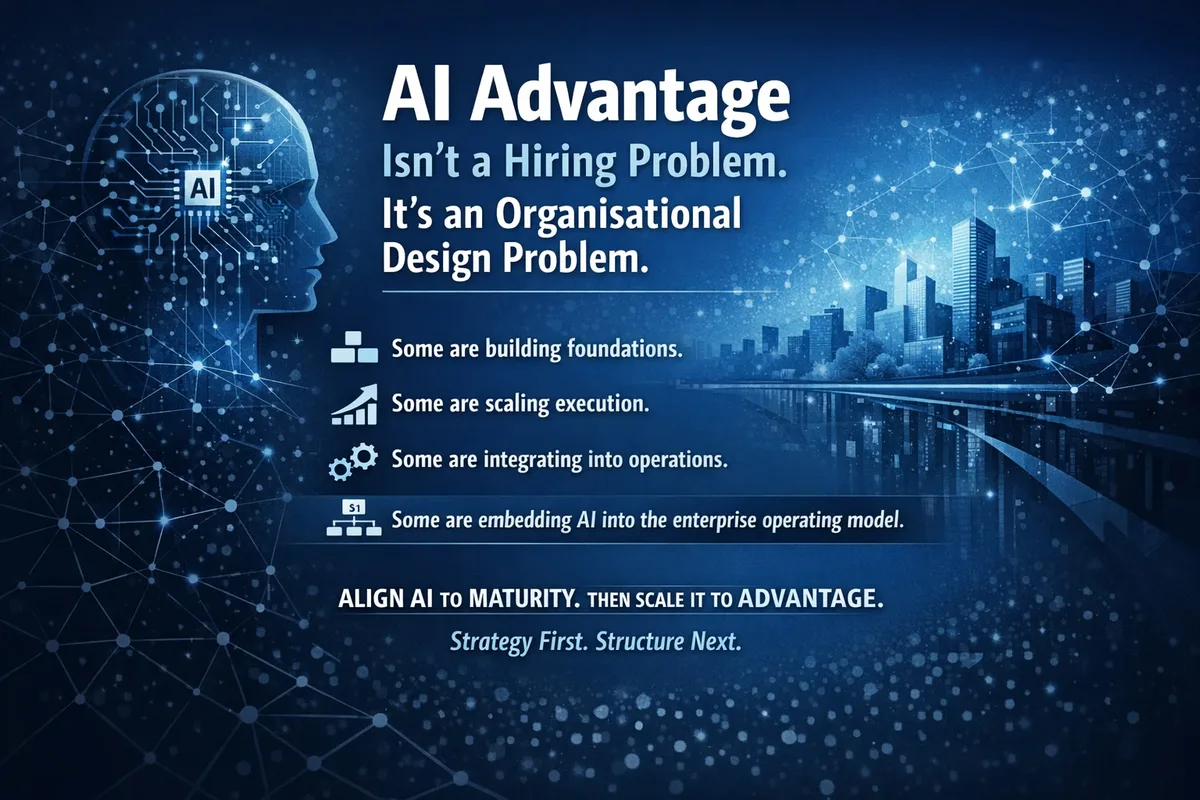
Every organisation wants AI advantage. But not every organisation needs the same AI team model. Some are still building core capability. Some are driving execution at scale. Some are embedding AI into business workflows. Some are making AI part of how the enterprise actually operates.
Yet leaders keep asking the same question: “What should our AI team look like?” The better question is: Where are we in our maturity, and where do we intend to compete?
AI team design is not a headcount decision. It's a maturity alignment decision.
Advantage follows a sequence
AI advantage follows a progression that most successful organisations end up walking, whether they name it or not:
- Strategy defines intent: clear direction on why AI matters to this business.
- Operating model enables execution: how that strategy turns into consistent delivery.
- Ownership creates accountability: clear decision rights and a name against each outcome.
- Capability builds foundations: skills, systems and expertise in place.
- Momentum sustains progress: continuous forward movement, not stop-start.
- Scale creates leverage: enterprise-wide impact through reuse and repeatability.
- Value compounds outcomes: the cumulative business result gets larger over time.
- Embedding AI into the enterprise operating model creates advantage: the point at which AI becomes part of how the business runs.
This is not a checklist. It's a sequence. Mis-sequence the journey and progress stalls. Align structure to maturity and advantage compounds.
Structure has to evolve with maturity
Teams need to evolve along this path. Static structures create drag on strategy, on execution and on value, because a team that was right for the pilot phase is almost always wrong for the scale phase, and vice versa.
Over the coming weeks, I'll outline how different organisation types should design AI teams as competitive assets, aligned to their stage of maturity and their ambition. Not roles. Not titles. Not org charts. Structure, capability and operating logic.
Competitive advantage in AI won't come from tools. It will come from how enterprises organise intelligence.