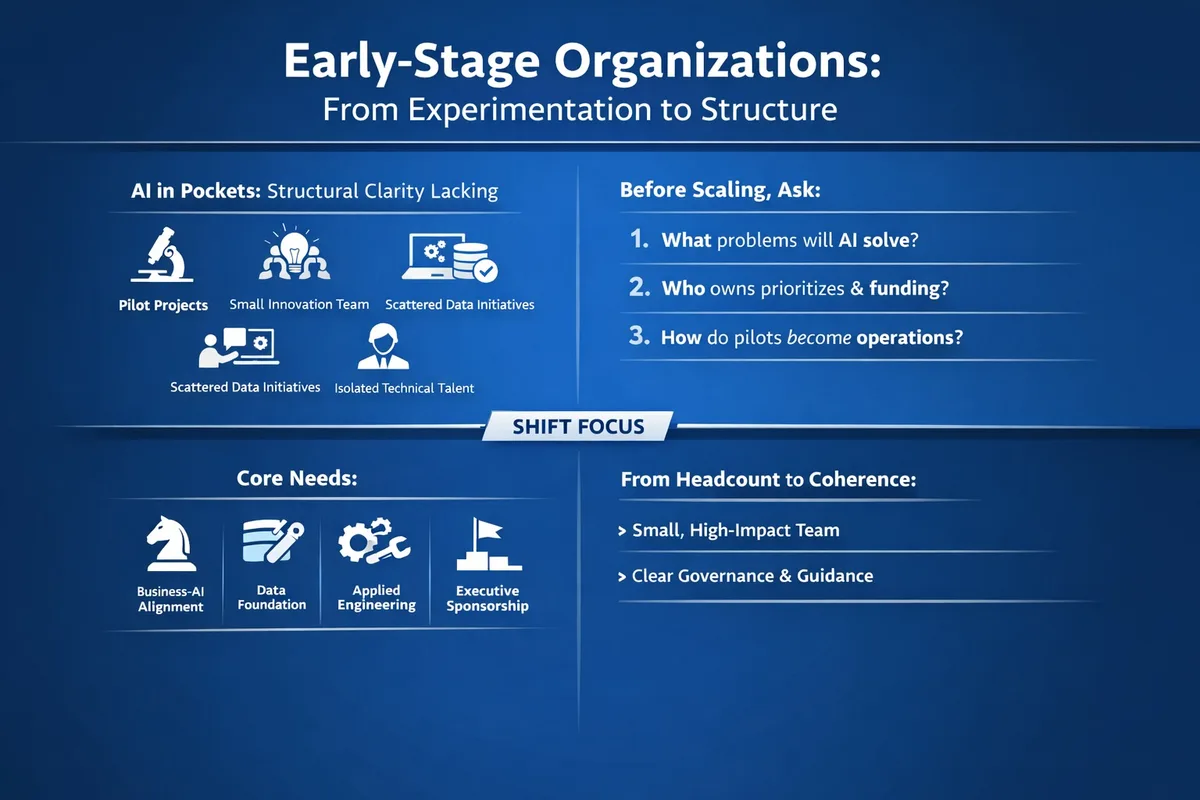
Most early-stage organisations don't have an AI problem. They have a structural clarity problem. AI exists, but it lives in pockets, and no one is quite sure how those pockets fit together.
A few pilots. A small innovation team. Vendors driving isolated use cases. Scattered data initiatives. Individual technical talent operating independently. Plenty of activity, enthusiasm and momentum, but very little repeatability.
Why hiring more data scientists doesn't fix it
The default reaction at this stage is predictable: “Let's hire more data scientists.” It rarely solves the underlying issue. Early-stage AI maturity is not a talent volume problem. It's a design clarity problem, and adding people to an unclear design just accelerates fragmentation.
Three questions to resolve before scaling
Before scaling, three questions have to be answered honestly:
- What strategic problems is AI expected to solve for this business?
- Who owns prioritisation and funding decisions across the AI portfolio?
- How do pilots transition into operational workflows once they succeed?
Without those, everything downstream will drift.
What early-stage organisations actually need
Not a large AI department. Early-stage organisations need a small, high-impact core team with the right mix:
- Business-to-AI translation capability: someone who can turn a business question into an AI problem and back again.
- Data foundation builders: because everything downstream depends on this.
- Applied engineering talent: practitioners who ship, not just prototype.
- Clear executive sponsorship: the political air cover that makes progress possible.
- Lightweight governance guardrails: enough to be trusted, not so much that nothing moves.
Focus, not headcount
The objective at this stage is not perfection. It's structural coherence. Early advantage doesn't come from headcount. It comes from focus and alignment.
Build clarity. Then capability. Then scale.
Next in the series: how scaling-stage organisations must redesign their AI teams for enterprise impact.
The most expensive mistake at the early stage isn't a bad pilot. It's hiring at speed into a structure that hasn't been designed yet.