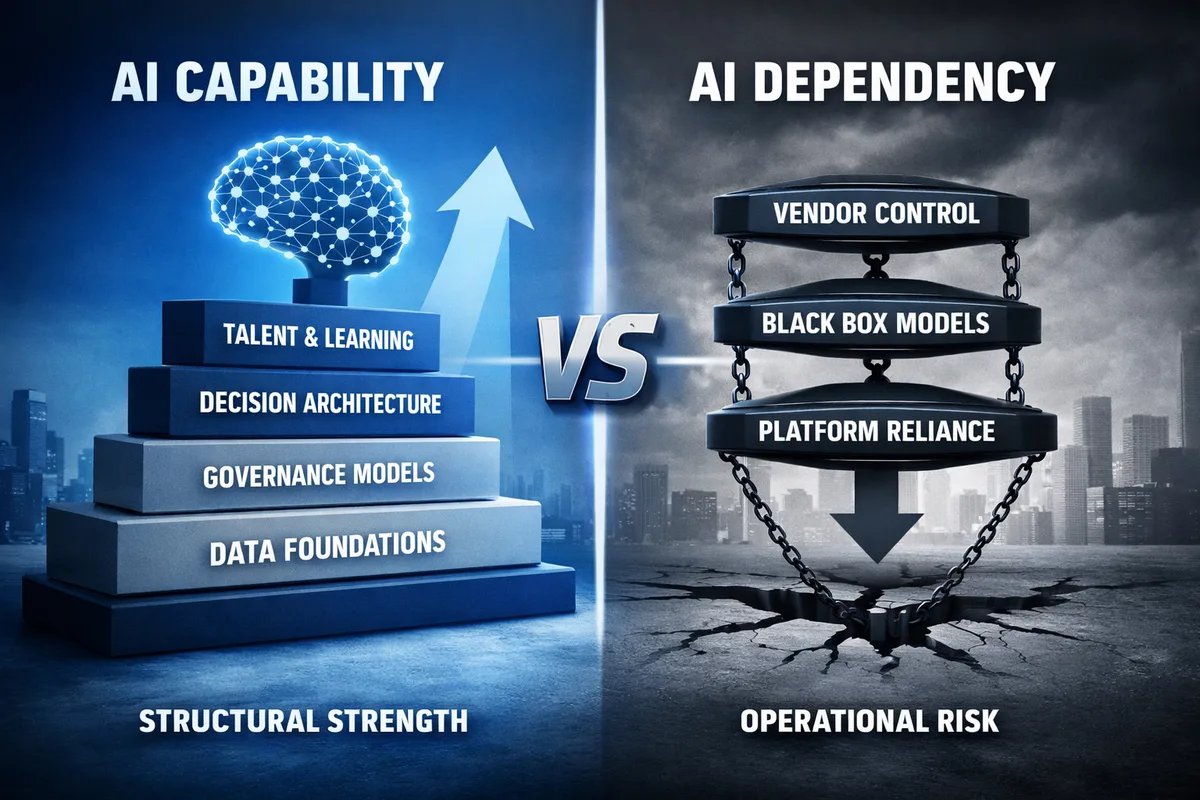
Most organisations are focused on using AI. Far fewer are focused on building AI capability. There is a growing risk of confusing adoption with resilience, and it will only become visible when the market shifts.
The dependency pattern
When AI is treated as a layer of tools, the enterprise becomes operationally dependent:
- Dependent on vendors for the intelligence at the core of key decisions.
- Dependent on platforms for the decision logic embedded in workflows.
- Dependent on models the enterprise doesn't fully govern or understand.
Dependency looks like productivity in the short term. Something that used to be hard is now easy. But the leverage sits with whoever supplied the intelligence, not with the enterprise using it.
What capability actually means
Capability is different. Capability means the enterprise owns the pieces that make AI durable:
- Its data foundations: the quality, lineage and access that determine what AI can even see.
- Its decision architectures: the framing of which decisions AI touches and how.
- Its AI governance: risk, ethics, compliance, and the standards for what “good” looks like.
- Its talent systems: the ability to build, retain and evolve internal AI skill over time.
- Its learning loops: the machinery that turns operational feedback back into better models.
Own those, and AI becomes structural. Rent them, and AI stays situational.
The next phase isn't more models
The next phase of AI transformation isn't about deploying more models. It's about building institutional AI capability that compounds over time: strategically, operationally and competitively. Long-term winners won't be the companies that adopted AI fastest. They'll be the ones that can adapt AI continuously without losing control, trust or coherence.
Which is the same reason I keep saying: AI advantage isn't technological. It's structural.
Ask honestly: is the enterprise building AI capability, or accumulating AI dependency?