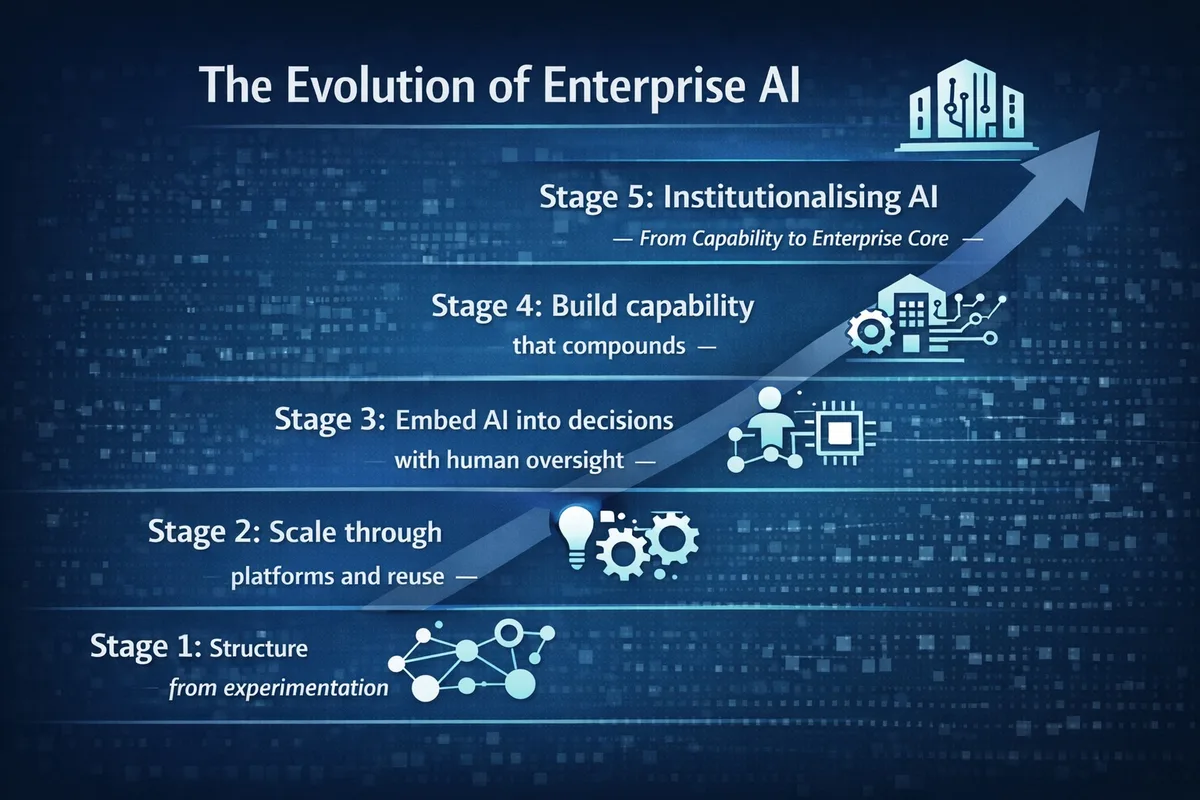
At the final stage of the journey, AI is no longer something the organisation is building. It becomes part of how the organisation operates at its core.
Many organisations succeed in building AI capability but still treat AI as a function, a team, or an initiative sitting alongside the business. Leading organisations move beyond that. They embed AI into:
- Core business processes.
- Core decision architectures.
- Enterprise platforms.
- Enterprise governance structures.
- The organisation's own operating rhythm.
AI is no longer visible as a separate effort, but it's present in every meaningful decision and workflow.
What changes at this stage
The role of the AI team fundamentally evolves, from building and enabling to orchestrating and governing at enterprise level. What that typically looks like:
- Federated ownership across business units, not a single central delivery team.
- AI embedded within core functions rather than delivered from the side.
- Enterprise-wide governance with clear accountability up to the board.
- Continuous monitoring and optimisation as part of the operating rhythm.
- Human oversight designed into decision systems, not layered on afterwards.
AI becomes a shared enterprise responsibility, not a specialised function.
Why this stage matters
Institutionalisation is where AI becomes a structural advantage: the kind competitors can't copy just by buying the same tools. At this point:
- AI scales without friction because the operating model is built for it.
- Capability sustains without dependency on any one vendor or individual.
- Decisions improve consistently because the intelligence is embedded, not consulted.
- The organisation adapts continuously. It's built to.
AI is no longer something the enterprise “deploys.” It becomes part of what the organisation is.
The full journey
This completes the arc: strategy → operating model → ownership → momentum → capability → scale → value → institutionalisation. The thread across every stage is the same one I keep coming back to: competitive advantage in AI is not built through tools. It's built through how enterprises organise intelligence.
Institutionalised AI stops looking like AI. It just looks like how the business works.